















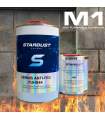

High-strength two-component varnish designed to protect surfaces and objects used in the food industry.
Total migration tests carried out by the IANESCO laboratory in accordance with NF EN 1186 and relevant regulatory standards.
3 different packaging options available as complete kits (hardener and thinner included) to be selected from the drop-down menu opposite:
A two-component polyurethane acrylic varnish designed for surfaces used in food-contact applications.
This finish, part of the acrylic range, is a high-strength two-component varnish designed to protect surfaces and objects used in the food industry.
This varnish is used, for example, to protect the exterior of an object, packaging, a tray, a worktop or a piece of equipment, provided that the surface is not in constant contact with food.
A coating sample underwent overall migration testing carried out by the IANESCO laboratory in accordance with NF EN 1186 and the relevant regulatory standards for materials intended to come into contact with foodstuffs.
Migration Test Report
The IANESCO report No. E16-16724 of 7 November 2016 concerns a coating applied to a stainless steel substrate. The tests were carried out for 2 hours at 70 °C using the following simulants:
- 10 per cent ethanol: average total migration 1.0 mg/dm²;
- 3 per cent acetic acid: 8.7 mg/dm²;
- vegetable oil: <1 mg/dm².
The limit stated in the report is 10 mg/dm². Under these test conditions, the overall migration results are in compliance.
Our high-resistance food-grade coating is a professional-grade product. It is suitable for industrial applications that comply with regulations, for example:
> Agri-food sector (wine, dairy, processing, etc.)
> The sector covering furniture and tools that may come into contact with food
> Manufacturing and design of products intended to come into contact with the skin (spectacles, watches, jewellery, etc.)
Exceptional features:
This varnish, which is suitable for items intended for food use – ‘indirect contact with food’ – is an ultra-glossy, ultra-hard finish that is completely impervious to liquids and oils, and resistant to exposure to detergents and other chemicals. It offers good flexibility and excellent temperature resistance.
What surfaces can it be used on?
All types of surfaces, provided they are well prepared, dry and sound. Depending on the material, a primer may be required. On old paintwork, light sanding is sufficient to restore the surface’s adhesion.
Important : The test report certifies only the results obtained from the sample submitted to the laboratory and under the specified test conditions. It does not constitute a general approval for all types of food contact, all temperatures or all exposure times. The user must verify that the product is suitable for their specific application.
"The coating system tested on a stainless steel substrate, comprising an epoxy primer and this topcoat, was subjected to total migration testing by IANESCO in accordance with NF EN 1186."
Method of application
For best results, the product should be sprayed using a spray gun (nozzle size 1.2 to 1.7)
1 or 2 coats, depending on the desired thickness.
Mixture
100 parts of food-grade lacquer + 50 parts of E225 hardener; can be diluted by 20 to 25 per cent
Formula
Solvent-based polyurethane acrylic
Yield : 12 m² per litre per coat
Our packaging options and offers:
- VARNISH Kit 1.75L (1L + 0.5L E225 hardener + 0.25L thinner)
- VARNISH Kit 8.5L (5L + 2.5L E225 hardener + 1L thinner)
- VERNIS Kit 26.6L (14.4L + 7.2L E225 hardener + 5L thinner)
VOC regulations : The product complies with the current European standard on VOCs (– 420 g/l when mixed)
Food-grade varnish approval – indirect contact: We issue a declaration of conformity.
► The IANESCO E16-16724 test report is available for download. It relates to the sample tested in 2016 under the conditions described in the report
1- Purpose
Assessment of the inertness of a material intended to come into contact with food. Overall migration test.
2- Reference documents:
- Standard NF EN 1186, Parts 1, 2 and 3.
- EC Regulation No 1935/2004 of 27 October 2004.
- EU Regulation No 10/2011 of 14 January 2011, as amended.
- DDCCRF Information Note 2004/64
two-component acrylic formulation
What is the temperature resistance of the finished product?
The product’s heat resistance ranges from 200 to 250°C, depending on the duration of exposure
What are the details of installing a zinc kitchen worktop?
This varnish, like any other varnish, will not adhere to zinc, stainless steel or galvanised steel.
It is necessary to apply an adhesion primer beforehand.
Here is a clear primer
special-effect paint, special finish, compliant with Directive 2004/42/EC, Annex II B (maximum VOC content for vehicle refinishing products, including special finishes of all types with a maximum VOC content of 840 g/litre)


.jpg)