
How to create a polished metal effect
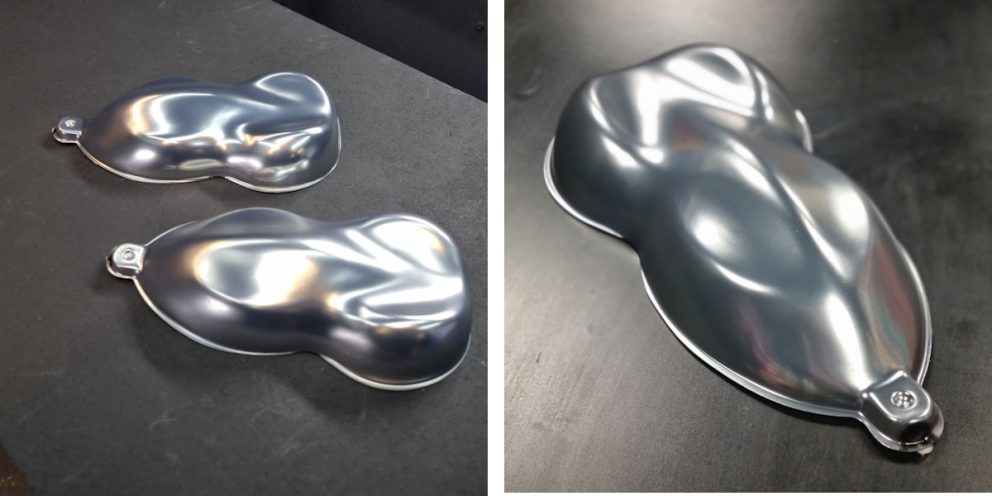
With a polished metal-effect paint, the aim is to replicate the appearance of genuine raw metal such as steel, stainless steel or aluminium. Unlike conventional metallic car paints, where each aluminium particle remains visible at close range, the aim here is to achieve a uniform, smooth and continuous surface, creating the illusion of a genuine metallic material.
The polished metal finish is available in a range of colours: natural aluminium, mirror-finish chrome or polished gold.
To achieve this effect, three elements are essential:
- very high-quality, perfectly uniform metallic pigments;
- an extremely flat arrangement of these pigments;
- a satin or semi-matt topcoat that preserves the raw metal finish.
With certain specialised aluminium paints, it is possible to achieve this polished metal finish. However, there is now a new alternative in the form of NeoChrome paint, which is not formulated using conventional aluminium, but rather a semi-precious metal.
Create a satin chrome finish with NeoChrome paint
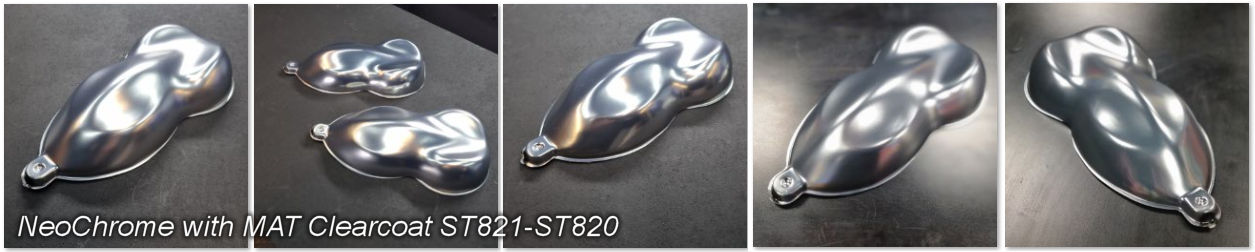
When applied in the conventional manner, NeoChrome paint produces a particularly intense mirror effect, with excellent opacity, very good resistance to UV light and corrosion, and is easier to apply than traditional aluminium-based chrome paints. It also takes to clear coating much more readily, which is a significant advantage for applicators.
We tested different types of clear coats — satin, semi-gloss and matt — on the NeoChrome paint to see how they affected the final appearance of the polished metal.
High-quality metallic pigments and VMP pigments
To understand how to achieve a genuine polished metal effect, you first need to understand how metallic pigments work.
In the field of paint, metallic pigments are mainly composed of aluminium. This metal is light, abundant and inexpensive, which explains its widespread use in metallic paints. These pigments take the form of micro-flakes which, when viewed under a microscope, resemble tiny flakes similar to Corn Flakes.
The higher the quality of the pigment, the finer, flatter and more uniform the particles are. Aluminium pigments are generally less than 70 µm in size, with a thickness of less than 5 microns.
VMP (Vacuum Metallised Pigments) aluminium pigments represent a much more advanced technology. They are manufactured by vacuum metallisation, whereby an extremely thin layer of pure aluminium is deposited onto a carrier film. This metallic layer is then detached and fragmented into ultra-flat, perfectly uniform micro-flakes. Thanks to this technology, VMP pigments offer far superior light reflection compared to conventional ground aluminium pigments. They therefore enable the creation of chrome, mirror or metallic effects with exceptional visual depth.

Pigment placement: the key to the polished metal effect
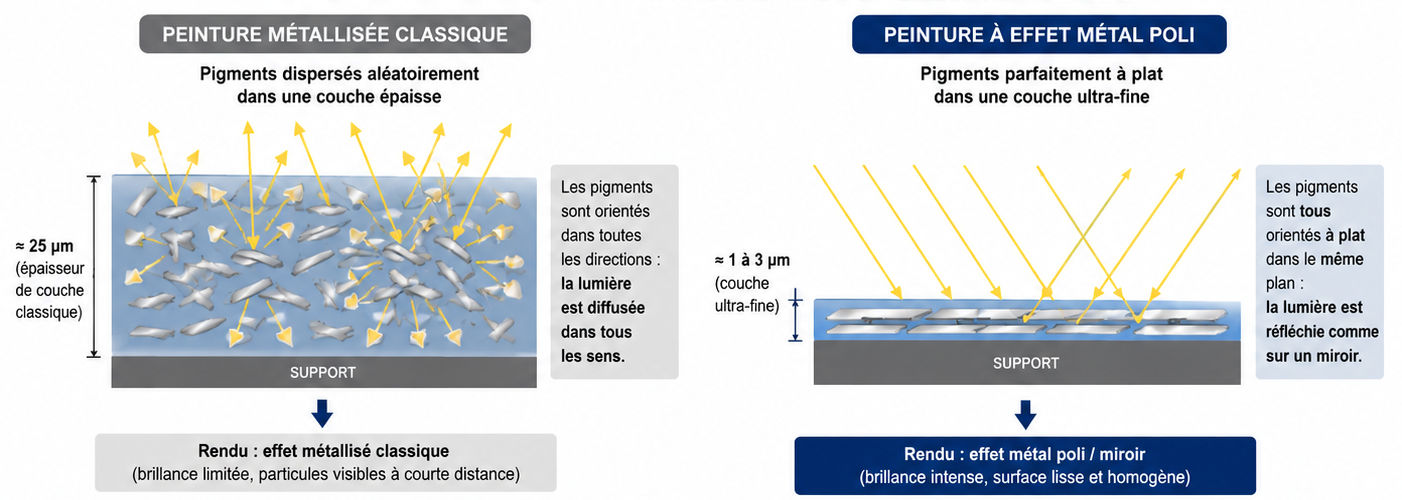
When metallic pigments are dispersed randomly in a paint, they settle in all directions. The result is a conventional metallic paint.
To create a genuine polished metal effect, all the pigments must, on the contrary, be perfectly aligned in an extremely thin layer. It is precisely this uniform alignment that allows the light to be reflected in the same way as a real metal surface.
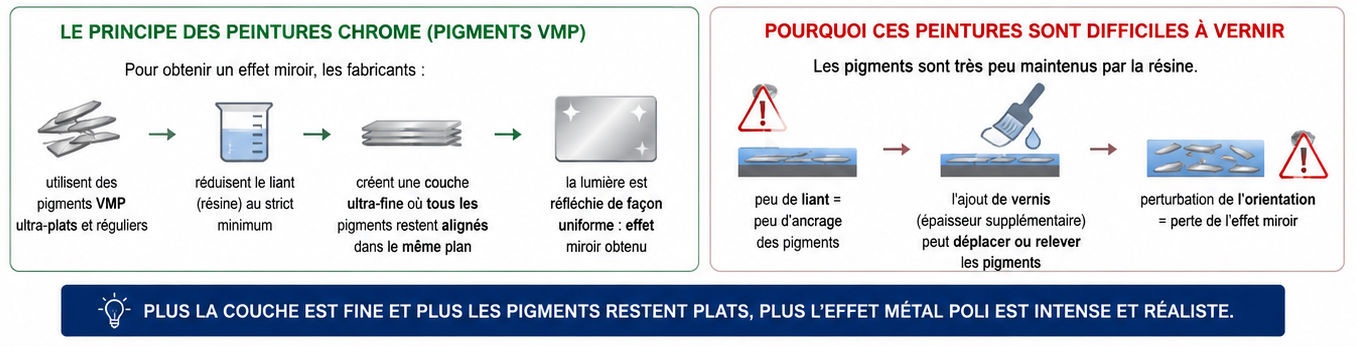
With conventional paint, this remains impossible, as the thickness of a single coat is generally around 25 microns – which is much greater than the thickness of the pigment itself. Take, for example, chrome paints formulated with VMP pigments: to achieve a mirror effect, manufacturers reduce the amount of binder to the absolute minimum. The aim is to create an ultra-thin layer in which all the pigments remain aligned in the same plane.
This is also why chrome paints are often difficult to clear-coat: the pigments are held in place by the resin only very loosely, and even the slightest addition of extra material can disrupt their alignment and impair the mirror-like effect.
The same principle applies to aluminium paints with a polished metal effect: the thinner the coat and the flatter the pigments lie, the more realistic the metallic effect will be.
Choosing the right clear coat to preserve the raw metal finish
The choice of clear coat plays a key role in the final appearance.
A glossy clear coat quickly gives a ‘car paint’ look, which is a far cry from the natural appearance of raw metal. In fact, most unpolished metals naturally have a satin finish rather than a mirror-like shine.
To maintain a realistic metallic finish, it is advisable to use a clear coat with a gloss level of between 20 and 60°. A clear coat such as ST820, with a gloss level of around 40°, offers, for example, an excellent balance between protection and visual realism.
It is important to bear in mind, however, that applying a matt or satin finish to a genuine mirror effect will automatically reduce the intensity of the chrome reflection.
The same phenomenon occurs with gold paints featuring a raw metal effect, such as the GOLD PREMIUM BC70, BC71, BC75 or BC76 paints. These formulations also use very high-quality metallic pigments and optimised particle positioning. If a topcoat that is too glossy is applied, the natural appearance of the gold metal is lost, giving way to an artificial, glossy paint finish.